Showing posts with label Multi-directional Scarf. Show all posts

Wednesday, December 28, 2011

The Ebb Tide Scarf

It’s always a bit difficult naming something, I think that’s why some great works of art are left untitled. Sometimes I employ a loose organic process to jog my brain. First I come up with names that I would never use: Sandy Ripples... sounds like a stripper; Tsunami... too soon; Duin-hir (River Lord)... I’ll get sued by the Tolkein Foundation; Esoteric Waves... too esoteric... etc. And when I’m done laughing, I think of more realistic possibilities for names.

For now I’m calling this pattern Ebb Tide. This winding, seven foot long scarf is a gift from Clive Baillie to his wife, Dawn. This original pattern is part of my Eleven Anthropology collection.

Much like the ribbed impressions left in the sand as the tide pulls away, Ebb Tide reminds me of a bygone day. With every twist and turn, it walks me down a familiar shore past the remains of sand castles, listening to the echo of crashing waves. I can almost feel the wet sand crushing between my toes.

This scarf is made with Aurora 4 (Karabella Yarns), a DK weight super washed merino. It’s very light and warm, perfect for chilly evenings on the beach. It has such an elegant drape — it unfurls like silken strands of seaweed.


Sunday, December 11, 2011

The Multi-directional Scarf — a Short Row Exploration

I recently hosted an instructional knitting circle at Headroom Digital Audio for executive producer Jennifer Hunt’s clients. I introduced the group to the Multi-directional Scarf. This technique lends itself handsomely to scrap yarns, and yarns of variegated color or varying thickness.

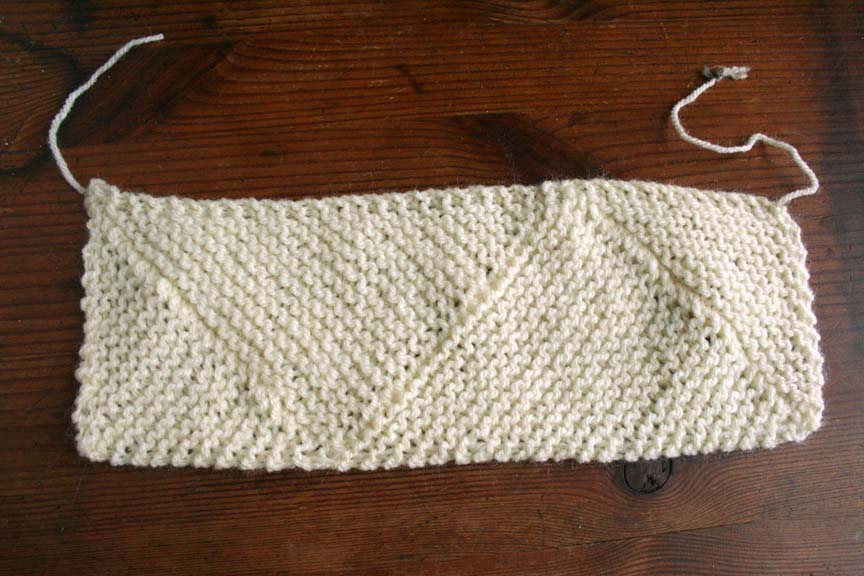
Introducing the Multi-directional Scarf This garter stitch scarf is 24 sts wide, but you can use any reversible pattern as long as it uses an even number of stitches. It’s made in sections that meet obliquely at perpendicular angles. The components are the first and last triangles, and a modular short-row section which you’ll repeat to a desired length. Short row is a method of increasing an area in the middle of your work by turning on a stitch and changing direction —a.k.a. “Wrap and Turn” (W&T). Combined with a series of increases and decreases it gives the usual straight path a diagonal orientation.

You’ll need:
- Worsted weight yarn (400 yds or more)
- US# 6 or 7 SPN
- 1 stitch marker
- Tapestry needle

First Triangle
Cast on 2 sts and work flat. Knit 1 front and back (k1fb), k1, turn.
*K1fb, knit to end of row, turn. rep from * until your triangle is 24 sts wide. Congratulations, you got through the first step.
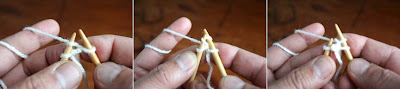
”Knit 1 Front and Back“ (k1fb) is a type of increase that can be made on every row. Knit into the first st keeping the loop on the left needle. Insert the right needle through the back of that same loop on the left needle and knit that st again. 
Modular Triangle
R01: (RS) K1fb, k2tog. Place a marker behind the first st on the left needle. Bring yarn to the front, sl1, return yarn to back, turn.

R02: Sl1, bring yarn to the back, knit to end of row. 

Changing the direction in the middle of your work by slipping and wrapping the yarn around a stitch is known as Wrap and Turn (W&T). Consecutive W&T rows increase a specific working area. This method is called Short Row.

R03: (RS) K1fb, knit until 2 sts before the marker, k2tog. Move marker behind the first st on the left needle. Bring yarn to the front, sl1, return yarn to back, turn.
R04: Sl1, bring yarn to the back, knit to end of row.

Repeat R03 and R04. Stop when you have 24 sts on the right needle. Be sure to remove the marker on the last row. Turn and repeat these modular instructions to create as many sections as you want until you have a suitable length for a scarf.

Last Triangle
R01: (RS) K1fb, k2tog. Place a marker behind the first st on the left needle. Bring yarn to the front, sl1, return yarn to back, turn.
R02: Sl1, knit to end of row.
R03: (RS) K1fb, knit until 2 sts before the marker, k2tog. Move marker behind the first st on the left needle. Bring yarn to the front, sl1, return yarn to back, turn.
R04: Sl1, knit to end of row.

Repeat R03 and R04. Stop when you have 2 more st to the left of the marker than on the right on your left needle (11 to the left, 13 to the right).

R05: (RS) k2tog, knit until 2 sts before the marker, k2tog. Move marker behind the first st on the left needle. Bring yarn to the front, sl1, return yarn to back, turn.
R06: Sl1, knit to end of row.

Repeat R05 and R06 until you have 4 sts on the left needle. Remove marker and finish this section as such: K2tog, k2tog, turn, k2tog. Cut yarn and sew in ends with a tapestry needle. Wash and air dry flat,  There you have it, the Multi-direction Scarf.

Saturday, October 29, 2011

Multi-directional Misnomer

Snow is sticking to cars and trees like a cold wet blanket. Fall looks more like winter today as Wall Street is occupied by protesters who attempt to exorcise the specter of corporate greed, job creation moves at a zombie-like pace, our middle-class is weakened  and more vulnerable to economic plunder, and our nation seems to have taken on extremely opposing political directions... and Halloween is here. This sounds more like the prologue from a movie about the Black Plague, doesn’t it?

On this cold wet night our group is going as a clan of cave people. Actually, we’re all going as our friend Chris who hosts his annual Halloween party dressed as a cave man. Luckily the party is just down the block. I made Stephanie a thick woolly scarf from six balls of of S. Charles “Natasaha” — a bulky luxury yarn made with 38% Wool, 33% acrylic, 24% Alpaca, and 5% Nylon. I got the last seven balls from Stitch Therapy. Who knew a cave woman could have it so good.

The Multi-directional Scarf, as it is called, is more of a misnomer. Much like our American politics it actually only has two directions that oppose each other obliquely. This method complements the character variegated yarns or yarns with varying thickness. It gives “Natasha” the appearance of fine Persian lamb. For a detailed tutorial click here.

Similar in technique to Entrelac, this scarf is knit in sections that meet perpendicularly. You can use any reversible pattern that has an even number of stitches.

A ribbed pattern using the same multi-directional method gives quite a dramatic result — soft elegant waves. By changing the direction in the middle of your work by slipping and wrapping the yarn around a stitch (W&T) increases the specific work area — this is called short row. Combined with a series of increases and decreases it creates a diagonal orientation.

The components of this Multi-direction Scarf are the first and last triangles, and a modular short-row section which is repeated to a desired length.