I better get more coffee going, I have to get this thing out sooner than later! The baby arrived a week early and I’m a few weeks behind. Two days before Christmas, Dan and Caroline’s son, Ea was born, You might say they gained a new womb-mate.
This baby quilt is a hexagonal modular knit made in varying shades of Lang Cashmere Tweed, a very soft, warm cashmere and fine merino blend. I made it a bit larger than infant size, Carrie can use it as a lap warmer as he outgrows it. This would also make a great pillow sham.
At 6 lbs. 12 oz and growing, he's a handsome little guy. Just look at that smile. I think orange will suit him fine. Christmas has passed, the New Year is here, and I'm still picking broken glass ornaments out of my foot. Hang in there kid, Uncle Tony is already half way there.
Showing posts with label Liloveve. Show all posts
Saturday, January 07, 2012
A Quilt for a New Womb-mate
Labels:
Baby Blanket,
Brooklyn,
Caroline Glemann,
Dan Davis,
Knitting,
Liloveve,
Modular Knit,
Quilt
Wednesday, July 27, 2011
The Red Phoenix Rises
We all seemed to have survives the heat wave over the weekend — highs in the 100s. It’s funny when 90° weather feels like a holiday. Dan and Caroline just got back from an Italian get-away. Although they had some hot days, I suspect it’s more charming abroad — the food was incredible! They brought back some squid ink risotto and herbed gray salt for me and Stephanie.
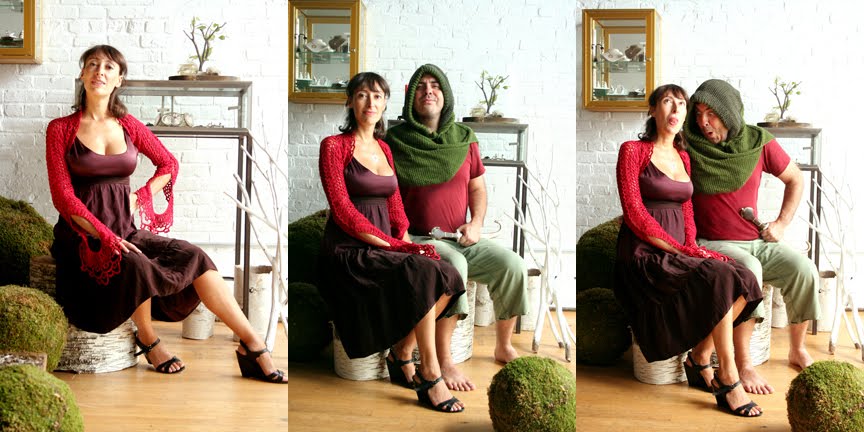
I made the Red Phoenix shrug for Caroline Glemann for her wedding... and she stills wears it well. Caroline designs exquisite jewelry, among them, Stephanie’s engagement ring. I took some prosperity photos at Liloveve, her jewelry studio.
The Red Phoenix shrug is made with the deepest-red antique cotton and silk using a combination of hairpin lace and traditional crochet. This inspired the white Way Wedding Shrug that I designed for Vogue Knitting’s Wedding Issue.
I love these sleeves, they make Caroline look like at Elven Queen.
The arching shapes were ispired by a type of beautiful red seaweed from Ireland called Dillisk. The Chinese refer to this style of long flowing sleeves are Phoenix. Hence the name. But I think it also reminds me of Jean Grey, the Phoenix from the X-men.
Armed and ready, Dan sat for a few with his hooded Green Ranger scarf. Seated here are an Elven Queen and a Dwarf King. Only a little prince or princess could complete this perfect mid-summer’s still life.
I made the Red Phoenix shrug for Caroline Glemann for her wedding... and she stills wears it well. Caroline designs exquisite jewelry, among them, Stephanie’s engagement ring. I took some prosperity photos at Liloveve, her jewelry studio.
The Red Phoenix shrug is made with the deepest-red antique cotton and silk using a combination of hairpin lace and traditional crochet. This inspired the white Way Wedding Shrug that I designed for Vogue Knitting’s Wedding Issue.
I love these sleeves, they make Caroline look like at Elven Queen.
The arching shapes were ispired by a type of beautiful red seaweed from Ireland called Dillisk. The Chinese refer to this style of long flowing sleeves are Phoenix. Hence the name. But I think it also reminds me of Jean Grey, the Phoenix from the X-men.
Armed and ready, Dan sat for a few with his hooded Green Ranger scarf. Seated here are an Elven Queen and a Dwarf King. Only a little prince or princess could complete this perfect mid-summer’s still life.
Labels:
Blather,
Brooklyn,
Crochet,
Hairpin Lace,
Liloveve
Tuesday, April 12, 2011
Enamel Workshop Part 2 —
Kiln Firing at Liloveve Studio
What’s in the oven? Well, it's not biscuits. This small kiln reaches temperatures of over 1500° F. It takes a watchful eye at these temperatures as metal and glass can melt and burn. All the skills we've acquired from torch-firing apply directly to kiln firing.
When working with high heat it’s important to dress correctly. Don’t wear synthetic fibers, wear cotton instead — potential disaster is only a sleeve-length away. Protective heat resistant gloves, tongs and long handled tools are required when kiln-firing — you can forget about wearing flip flops.
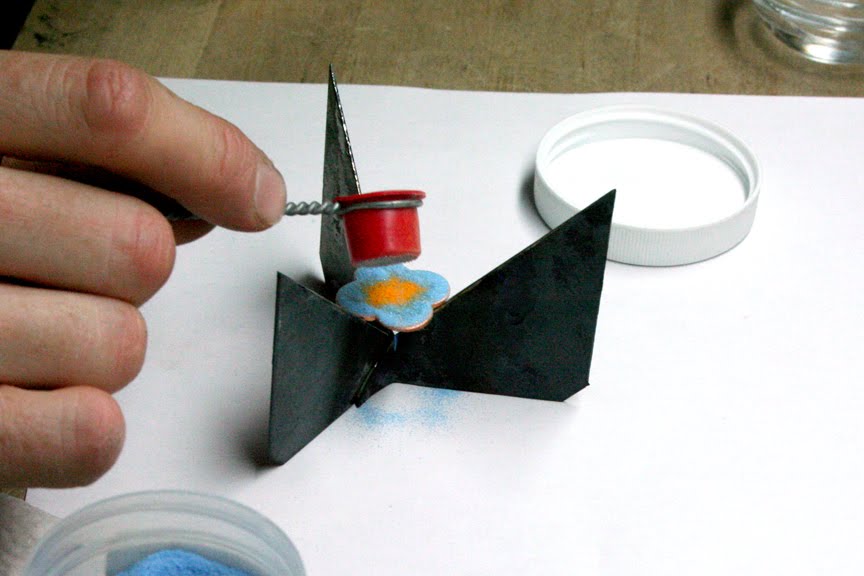
Wet packing is another method of applying glass powder by making it into a paste with one part Klyr-fire adhesive and four parts distilled water. After cleaning and buffing a copper surface, the paste is applied with a brush — it's about as viscous as yogurt.
Much like guache or watercolor, the wet paste should be completed in one application and then allowed to dry before further decoration and firing. Many water color effects can be used using the wet-packing technique... blending, gradation, spot coloring... etc.
Sgraffito comes from the Italian word sgraffiare which means “to scratch.” This decorative treatment is used on ceramic tiles, wall treatments, and of course enamel jewelry.
Instructor Emilie Shapiro gave us a detailed demonstration. The finished base color is mars red — first fired, cooled, and cleaned. An opaque blue paste is wet-packed onto the surface and allowed to dry. A design is scratched through the paste with a stylus to reveal the mars red base below, then it’s kiln-fired. Opaque colors are recommended for sgraffito, but transparent layers can be applied afterwards at separate firings.
To prevent warping a layer of counter enamel is applied and fired to one side. Counter enamel is mixed from left-over glass colors. Without a counter enamel, long thin shapes such as this test strip bend like plastic while firing.
In this test strip silver foil is applied, and then layered with more transparent color. Multiple transparent layers deepen in color to create a lustrous surface.
It take a steady patient hand and many trips to the kiln to achieve this gem-like quality. Looks good enough to eat!
Liloveve Studio is owned operated by Caroline Glemann, a designer of fine jewelry. For more information about this enamel class and other classes at Liloveve, and to learn more Caroline Glemann’s jewelry, visit the studio website: www.liloveve.com.
When working with high heat it’s important to dress correctly. Don’t wear synthetic fibers, wear cotton instead — potential disaster is only a sleeve-length away. Protective heat resistant gloves, tongs and long handled tools are required when kiln-firing — you can forget about wearing flip flops.
Wet packing is another method of applying glass powder by making it into a paste with one part Klyr-fire adhesive and four parts distilled water. After cleaning and buffing a copper surface, the paste is applied with a brush — it's about as viscous as yogurt.
Much like guache or watercolor, the wet paste should be completed in one application and then allowed to dry before further decoration and firing. Many water color effects can be used using the wet-packing technique... blending, gradation, spot coloring... etc.
Sgraffito comes from the Italian word sgraffiare which means “to scratch.” This decorative treatment is used on ceramic tiles, wall treatments, and of course enamel jewelry.
Instructor Emilie Shapiro gave us a detailed demonstration. The finished base color is mars red — first fired, cooled, and cleaned. An opaque blue paste is wet-packed onto the surface and allowed to dry. A design is scratched through the paste with a stylus to reveal the mars red base below, then it’s kiln-fired. Opaque colors are recommended for sgraffito, but transparent layers can be applied afterwards at separate firings.
To prevent warping a layer of counter enamel is applied and fired to one side. Counter enamel is mixed from left-over glass colors. Without a counter enamel, long thin shapes such as this test strip bend like plastic while firing.
In this test strip silver foil is applied, and then layered with more transparent color. Multiple transparent layers deepen in color to create a lustrous surface.
It take a steady patient hand and many trips to the kiln to achieve this gem-like quality. Looks good enough to eat!
Liloveve Studio is owned operated by Caroline Glemann, a designer of fine jewelry. For more information about this enamel class and other classes at Liloveve, and to learn more Caroline Glemann’s jewelry, visit the studio website: www.liloveve.com.
Saturday, April 09, 2011
Enamel Workshop Part 1 —
Sifiting & Torching at Liloveve Studio
| “Over-fired Cuff”' by Emilie Shapiro (vitreous enamel on free-form copper) |
| Sgraffito is a decorative a technique of scratching a wet top layer to create linear designs. |
It helps to have some practical knowledge of metalwork. In this first series of classes, Emilie helped us master the skills and techniques of firing colored glass onto copper by dry-sifting, and wet-packing.
We had our hands full applying layer upon layer yo build a solid opaque surface. Our first project involved sgraffito, an Italian technique in which a design is scratched into a wet layer of enamel to reveal a contrasting color of finished enamel below. It works best with opaque colors.
A copper surface is first cleaned well with denatured alcohol, then buffed dry and treated with Klyr-fire, a cellulose adhesive. Traces of hand grease and impurities affect how well the color covers as it is heated. In this lesson powdered glass is applied by sifting evenly onto the treated surface. Multiple colors can be applied to created an organic gradation but it's best not to blend a new color with this method.
Of course my favorite part of this class was Torch Firing with an acetylene torch. Isn’t that every boy’s dream? This is the most practical way to learn how different materials react to high concentrated heat (“high fire”). You literally can watch metal and glass melt and oxidize. If you're not careful you might melt your project to the trivet — I learned that the hard way.
Work carefully and quickly. As you wait for the copper to turn a bright shade of orange you must also watch the texture of the glass as it fuses. The powdered glass first takes on the texture of granulated sugar as you move the torch around from below. It’s finished when it takes on orange peel texture. When glass is heated to the point of burning it’s called “over-firing.” This effect is similar to raku pottery.
The finished enamel is moved to a clay surface to cool, then is pickled in a low acid bath. More layers can be applied to create different effects as you can see from the examples we made in this class.
Copper is a great conductor of heat, it also has a lower melting point than the steel trivet used for support. Other types of metal for enamelware are fine gold, and sterling silver.
In this studio class we gained a practical knowledge of all tool sand materials for working with enamel. This class has been nothing less than fascinating, but there’s still so much more to learn. Perfecting these techniques lead us to the making cloisonné jewelry. Cloisonné is a Far Eastern technique refined by the French. The word “cloison” is French for partition. This enamel technique involves inlaying different colors into separate compartments made from thin strips of wire. It resembles a painting made from jewels.
| In this class I enameled copper buttons to look like mother of pearl and other oxidized metals, clever no?. |
To learn more about precious metal and and jewelry making workshops at Liloveve Studio, and to see Caroline Glemann’s work visit her studio website: www.liloveve.com.
Emilie Shapiro is contemporary jewelry designer and metalsmith who received her BFA in Art & Design from Syracuse University. She has studied at Alchimia, a contemporary school of Italian jewelry in Florence, with artist Peter Bauhuis. She managed production at Pamela Love and Allforthemountain and has since launched her own line of jewelry and body adornment. To see more of Emilie Shaprio’s work, visit her website: www.emilieshapiro.com.
Subscribe to:
Posts (Atom)